
1up is an AI-powered platform founded by George Avetisov, helping teams auto-fill questionnaires and RFPs.
When George first reached out, he had a clear vision – he wanted 1up to become a recognized thought leader in the AI sales space, competing against far bigger players with much deeper pockets.
The problem?
Limited budget, limited visibility, and the challenge of standing out in a crowded AI content market filled with enterprise-level competitors.
The founder, George contacted me because he had a problem…
Before we worked together, most of 1up’s traffic came from referrals and branded searches. The blog had potential, but was not structured to win in search. Content lacked clear keyword targets, the site had no content clusters, and the writing was not aligned with buying intent.
This created three issues:
Low visibility to new prospects searching for AI sales tools
No strong topical authority in the segments where 1up wanted to lead
No system for producing consistent content that compounds over time
The goal was simple. Create a search-driven strategy that would capture qualified traffic, build topical authority in AI and sales, and make every piece of content work harder without increasing the budget.
To make every dollar count, I implemented a lean, data-driven content strategy tailored to 1up’s strengths – unique insights, fresh data, and strong social engagement.
The first step was to identify where 1up could realistically outperform larger competitors. I performed a keyword gap analysis using Ahrefs and Google Trends to uncover topics where buyer intent was high and the competitive landscape was manageable.
The core targets included:
Loopio alternatives
Sales enablement trends
AI sales reps
AI and security questionnaires
AI and competitive intelligence
These topics aligned directly with what 1up solves. They attracted readers who were not only curious about AI, but who were actively researching tools and workflows related to the problems 1up addresses.
The result was a clear content roadmap focused on strategic visibility, not chasing every AI keyword on the internet.
1up had a strong asset in the State of AI and Sales Report. Instead of letting it operate as a one-time campaign, I repurposed it into a continuous flow of high-performing content.
This included:
SEO-optimized blog articles breaking down key insights
Social posts that highlighted major findings and linked back to the site
Mini deep dives that explained trends from the report in plain language
Internal linking strategies that connected each related article and kept readers on the site longer
This created a compounding effect. Every insight from the report became an opportunity for organic traffic, social visibility, and improved topical authority.
To rank consistently, 1up needed to be recognized as a specialist, not a generalist. I built tight content clusters around three core pillars.
AI in sales
AI in security questionnaires
AI in competitive intelligence
Each cluster included articles that answered related questions from multiple angles. Internal linking supported discovery and helped Google understand the structure of the content. Titles, headers, and schema were optimized to reinforce relevance and authority.
This made 1up stand out in a noisy market where most competitors created broad, unfocused AI content.
Here is the simple breakdown of how this project came together from start to finish.
A full keyword and competitor gap analysis
A content strategy with clear clusters around AI and sales
SEO-optimized blog posts aligned to high-intent keywords
Repurposing the State of AI and Sales Report into multiple evergreen articles
Internal linking to strengthen topical authority
On-page optimization across each article
Support for social content that tied directly into high-performing topics
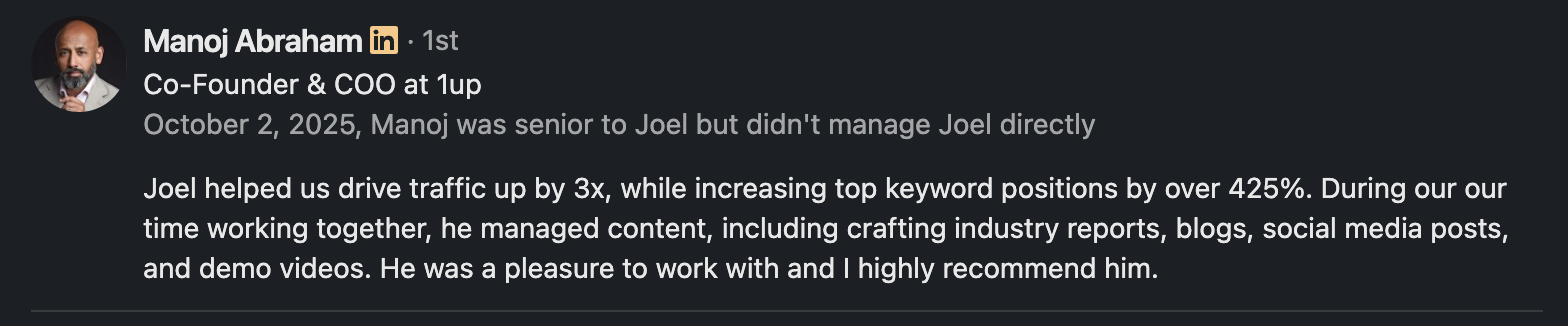
The results began to compound after a few months. The increase in organic traffic was driven by a combination of better keyword targeting, improved content structure, and repurposing long-form research into evergreen articles.
Traffic increased from around 1,500 visitors per month to more than 5,000 monthly organic visitors
Hundreds of new non-branded keywords began ranking
Several priority articles achieved top rankings for competitive phrases
Social content began outperforming previous benchmarks due to tighter alignment with search data
High-value inbound leads increased as more readers discovered 1up while researching AI-driven sales solutions
All of this happened without increasing spend, hiring a full content team, or relying on paid distribution.